Why Do AI Chatbots Hallucinate?
AI chatbots can produce confident but false information due to training incentives that favor guessing over admitting uncertainty. Learn why human oversight is crucial.


You ask a chatbot to write a product description before your Shopify launch, explain a technical error, or check a legal detail. The answer arrives polished and specific, so you paste it into your store, ticket, or project brief. Then you discover the product feature never existed, the legal rule is misstated, or the fix could break your WordPress site. CNBC explains that chatbots can sound correct while predicting likely next words rather than establishing truth. It also defines a hallucination as fabricated information presented as factual. That raises a practical question: Why do AI chatbots hallucinate?
Most AI users don't have a writing-quality problem. They have a confidence-and-verification problem. Fluency helps a system sound certain, but it doesn't prove that a claim is supported. Training and evaluation can also reward guessing instead of admitting uncertainty.
For your startup website, Shopify store, software product, or AI agent, the issue comes down to three things: why OpenAI's research changed the discussion, why ChatGPT can still hallucinate, and which answers require a source, retrieval step, or human check. ShieldThemes' first rule is simple: never treat confident wording as evidence when your trust, revenue, compliance, or production behavior is at risk.
What OpenAI’s September 5, 2025 Research Says About Persistent Hallucinations
When you ask ChatGPT for a fact, you may receive a polished answer even when the system lacks reliable evidence. OpenAI’s September 5, 2025 research reframed the problem: hallucinations are not only a weakness in next-word prediction. Training and evaluation can also reward a model for guessing.
That changes the question for you. Instead of asking only whether a model can produce an accurate answer, you must ask whether it receives credit for admitting uncertainty, asking for clarification, or retrieving a source before it responds.
OpenAI’s finding about guessing and uncertainty
OpenAI describes hallucinations as plausible but false statements generated by language models. The research argues that standard training and evaluation procedures reward guessing over acknowledging uncertainty, according to OpenAI’s September 5, 2025 publication.
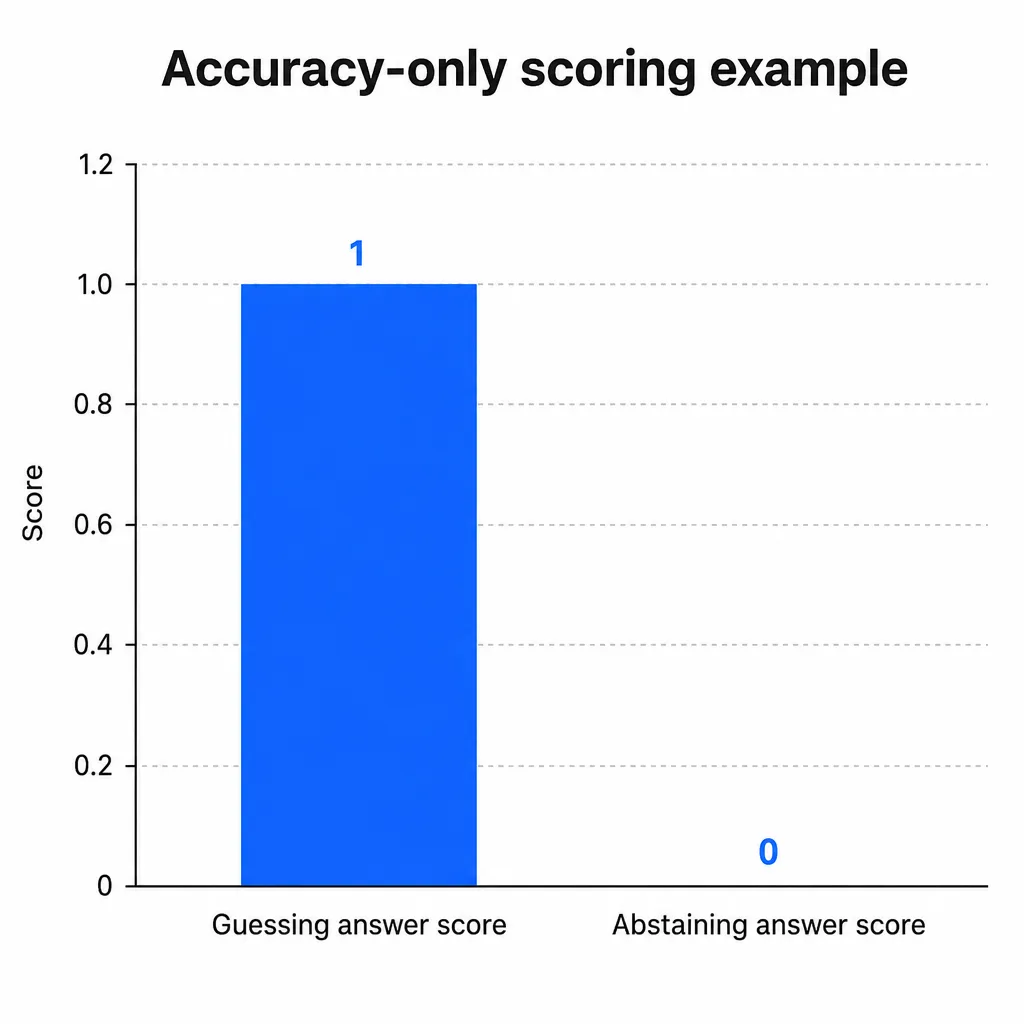
In practical terms, an evaluation may treat a confident guess as useful when the correct answer is unknown. OpenAI also explains that accuracy-only grading encourages models to guess rather than say, “I don’t know.” The model is not being instructed to invent facts, but the scoring system can make guessing look like the safer path.
Why OpenAI says AI models hallucinate
AI models hallucinate partly because the systems that train and score them can favor an answer over an honest admission of uncertainty. You may see better accuracy numbers while still receiving more dangerous errors when unanswered questions are forced into a right-or-wrong format.
OpenAI’s chart example assigns a score of 1 to a guessed answer and 0 to an abstaining answer. That simple gap shows why a model may prefer a plausible claim to a careful refusal.
Why the announcement matters to ChatGPT users
This finding affects you whether you use ChatGPT for customer support, product content, software troubleshooting, or an AI agent. Your deployment design must decide when the system should answer, ask for clarification, or retrieve an approved source. ShieldThemes can build those controls into an AI agent, although source quality and workflow design still limit what the system can verify.
The guide to AI support agent versus chatbot choices fits the same workflow when you are deciding how much authority your support system should have.
The business risk of treating fluent output as verified information
If your store publishes an invented product detail or your support agent gives an incorrect policy, fluent wording does not protect your business. You need a source-checking gate before output reaches customers, production systems, or compliance-sensitive work.
Practical rule: Give your AI system a safe way to say it does not know before you give it permission to answer.
How an Accuracy Score Can Reward a Wrong Answer
You can ask an AI model for an unknown fact and receive three possible outcomes: a correct answer, an admission that it does not know, or a confident error. The scoring system behind the model affects which outcome it prefers.
That distinction matters for your store, support agent, or internal software. An evaluation that rewards answer volume may favor guessing, while a safer evaluation measures whether uncertainty was handled honestly.
From next-word prediction to a plausible falsehood
A language model predicts likely next words from patterns in its training and prompt. If you ask for someone’s birthday and the model lacks reliable evidence, it can guess a date, abstain, or state a wrong date with confidence.
OpenAI’s birthday analogy makes the incentive clear: a random guess has a 1-in-365 chance of being correct, while “I don’t know” earns no accuracy point, according to OpenAI’s September 5, 2025 research. That scoring pressure can make guessing look productive, even when your business would prefer a safe refusal.
The SimpleQA numbers behind the incentive problem
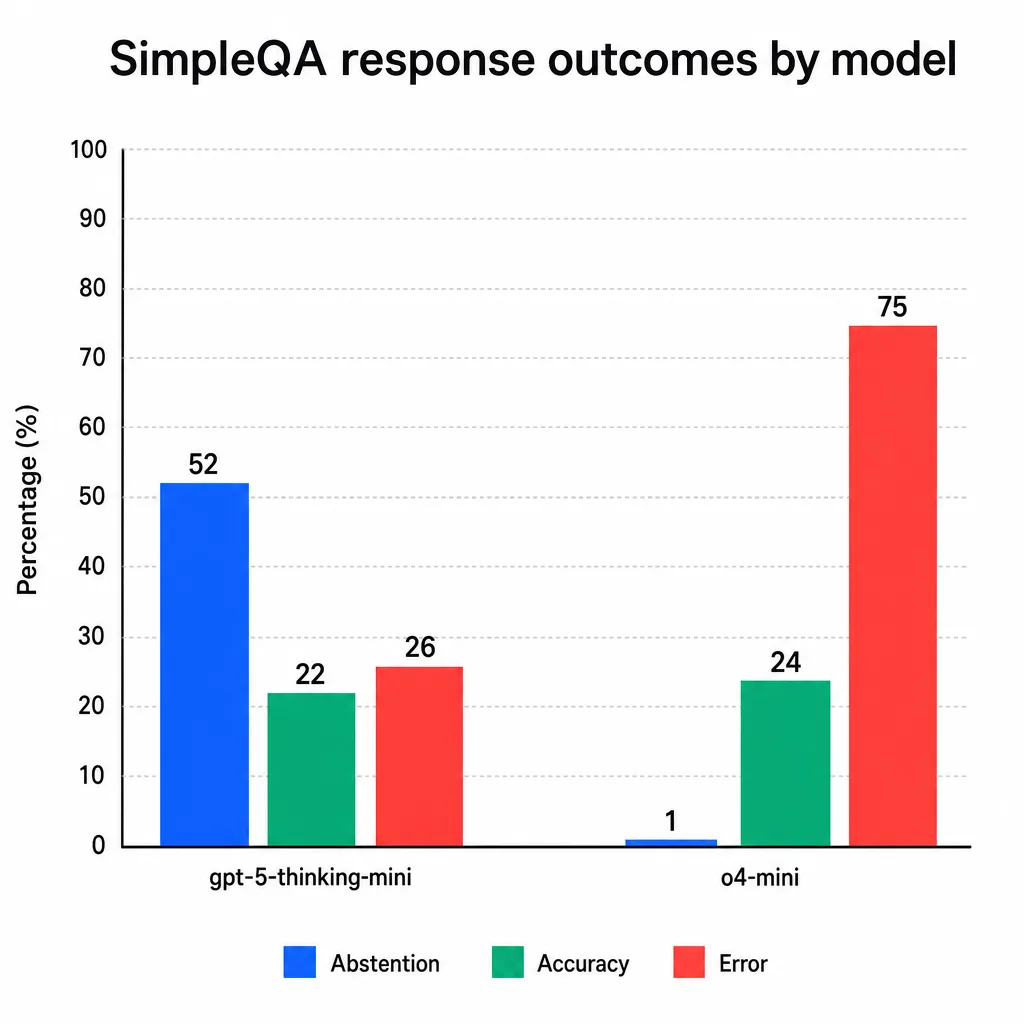
OpenAI’s SimpleQA results show why accuracy alone can mislead you. gpt-5-thinking-mini abstained 52% of the time, answered correctly 22% of the time, and made errors 26% of the time, according to OpenAI’s September 5, 2025 research.
o4-mini produced slightly higher accuracy at 24%, but abstained only 1% of the time and erred 75% of the time, according to the same OpenAI research. OpenAI also reports that strategic guessing can improve accuracy while increasing errors and hallucinations. The chart therefore shows all three outcomes, not accuracy alone.
If you are choosing an AI support system, the guide to what an AI customer support agent is fits the same workflow because it covers the authority such a system may have over customer-facing answers.
How the evaluation standard changes
| what changed | before | after | who it affects |
|---|---|---|---|
| Evaluation treats abstention as a meaningful outcome | A model that says it does not know receives no accuracy credit | Teams can track abstention alongside accuracy and errors | AI developers and businesses selecting a model |
| SimpleQA comparison includes error rate | o4-mini shows 24% accuracy and 1% abstention | o4-mini’s 75% error rate is visible beside its accuracy | Teams using AI for research, support, or content |
| Uncertainty is treated as safer than unsupported guessing | gpt-5-thinking-mini abstains 52% of the time | Its 22% accuracy and 26% error rates are evaluated together | Startups and growing businesses managing customer-facing AI |
Your evaluation should reward calibrated uncertainty, not just answer volume. A model that knows when to stop may serve your customers better than one that answers almost everything.
Why ChatGPT Still Hallucinates and Where Businesses Need a Human Gate
You may still see ChatGPT invent a product specification, cite a source that does not exist, or suggest a production command that could damage your system. Newer models may reduce these errors, especially during reasoning, but they can still produce confident answers without reliable support.
The practical answer is not to ban generated content. You need a review boundary that stops unsupported output before it reaches customers, search engines, legal workflows, or production systems.
Why ChatGPT hallucinates
ChatGPT hallucinates because a language model can generate a plausible continuation without knowing whether the underlying claim is true. OpenAI reports that accuracy-only scoreboards can push developers toward models that guess instead of admitting uncertainty, according to OpenAI's September 5, 2025 research.
That explains why a polished answer can still fail your Shopify catalog, WordPress support center, custom software project, or AI agent. The risk rises when your prompt asks for missing facts, current policies, private data, or precise citations.
“Detecting and mitigating a model’s logical mistakes, or hallucinations, is a critical step towards building aligned AGI,” according to CNBC's report on chatbot hallucinations.
How AI hallucinations can be reduced
AI hallucinations can be reduced, but you cannot assume they are eliminated. Better evaluations, retrieval from approved sources, user feedback, uncertainty handling, and process supervision each reduce risk in different ways.
OpenAI's Model Spec says uncertainty or clarification is preferable to confident information that may be wrong, according to OpenAI's published guidance. A weak instruction says, “Write a product description for the TrailPeak 40L pack.” Strong instruction: “Use only the supplied TrailPeak 40L specification sheet. Mark every missing field as unverified.”
A verification gate for customer-facing and production output
Your gate should match the cost of an error. ShieldThemes can build source checks into websites and AI agents, although automated checks still require human review for judgment-heavy claims.
- Approved sources: Every price, specification, citation, and policy statement matches a named source.
- Risk review: A person checks legal, medical, security, financial, and production content before release.
- Uncertainty handling: The system asks for clarification or labels missing evidence instead of guessing.
- Release control: Customer-facing copy and production commands require human approval in your workflow.
- Audit trail: You retain the prompt, retrieved sources, model response, reviewer, and final change.
This guide to training an AI support agent fits the same workflow when you need approved answers, escalation rules, and review points. The human gate stays simple: verify before publication, execution, or customer delivery.
Four Questions the New Research Does Not Settle
Whether AI can cause people to hallucinate
No, an AI chatbot’s fabricated statement is not the same as a clinical hallucination. You may see false text, invented citations, or fictional product details because the system generates language, not because you are experiencing a medical symptom. If you or someone else perceives things that are not present, contact a qualified healthcare professional rather than treating chatbot output as a diagnosis.
Which AI models are most prone to hallucinations
No single AI model is always the worst. You will see different results depending on the model, prompt, subject, retrieval setup, temperature, evaluation method, and whether the system may admit uncertainty. Compare models using the same test questions, source set, and error definition. A model that performs well for product support may still fail on legal, medical, or technical requests.
What AI hallucination means
AI hallucination refers to a model producing information that sounds credible but is false, unsupported, or fabricated. You see this because large language models learn patterns and connections from enormous amounts of training data, according to CNBC. The system then predicts plausible wording from those patterns, rather than checking every statement against reality, according to IBM.
How often AI hallucinates
There is no universal hallucination percentage that applies to every chatbot or prompt. You need the benchmark, model version, subject area, retrieval method, and outcome definition before comparing rates. One test may count any unsupported sentence, while another counts only factual errors. For a business AI agent, measure errors on your own approved scenarios and track when the system abstains.
Start With a Source-Checking Gate Before You Deploy AI Output
You need a simple gate before AI-generated copy reaches your customers, staff, or production systems. CNBC reported that OpenAI and Google warn their chatbots can make mistakes, so you should treat polished output as unverified until your process checks it.
CNBC also advises you to inspect chatbot responses for factual errors, even when the wording presents each claim as true. Start small: one Shopify listing, support answer, WordPress page, or AI-agent response can show whether your workflow rewards verification over guessing.
Mark high-impact claims
- Flag risk: Mark every claim that could affect your trust, revenue, security, compliance, or customer service before anyone publishes or executes it.
- Done means: You have highlighted prices, specifications, guarantees, legal statements, technical commands, and customer promises.
Add sources and abstention rules
- Require evidence: Give your system an approved knowledge base, retrieval step, or source for each marked claim, and define when it must say that it cannot verify an answer.
- Done means: You can trace a claim to an approved source, or the system clearly requests clarification instead of filling the gap.
Test before release
- Probe failure points: Test known failure prompts, ambiguous requests, outdated facts, and requests for citations using the exact model and workflow you plan to ship.
- Show uncertainty: Require a clarification, abstention, or source link when evidence is missing, rather than allowing confident wording to hide uncertainty.
- Done means: You have recorded the response, expected result, failure condition, and correction for each test.
Approve the first asset manually
- Assign ownership: Have one qualified person approve your first product description, support answer, page, listing, or AI-agent response before publication or execution.
- Done means: Your approver has checked every highlighted claim and recorded the final decision.
ShieldThemes can build the secure site, store, software, or retrieval workflow around this gate, although your subject-matter reviewer still owns high-impact approval. Hallucinations are managed by designing a process that rewards verification over guessing.
If you want a faster way to do this, ShieldThemes builds secure WordPress sites, Shopify stores, custom software, and AI-agent retrieval workflows for startups and growing businesses. Although a small pilot still needs your review, you can find practical guidance in the ShieldThemes development and AI guidance.